
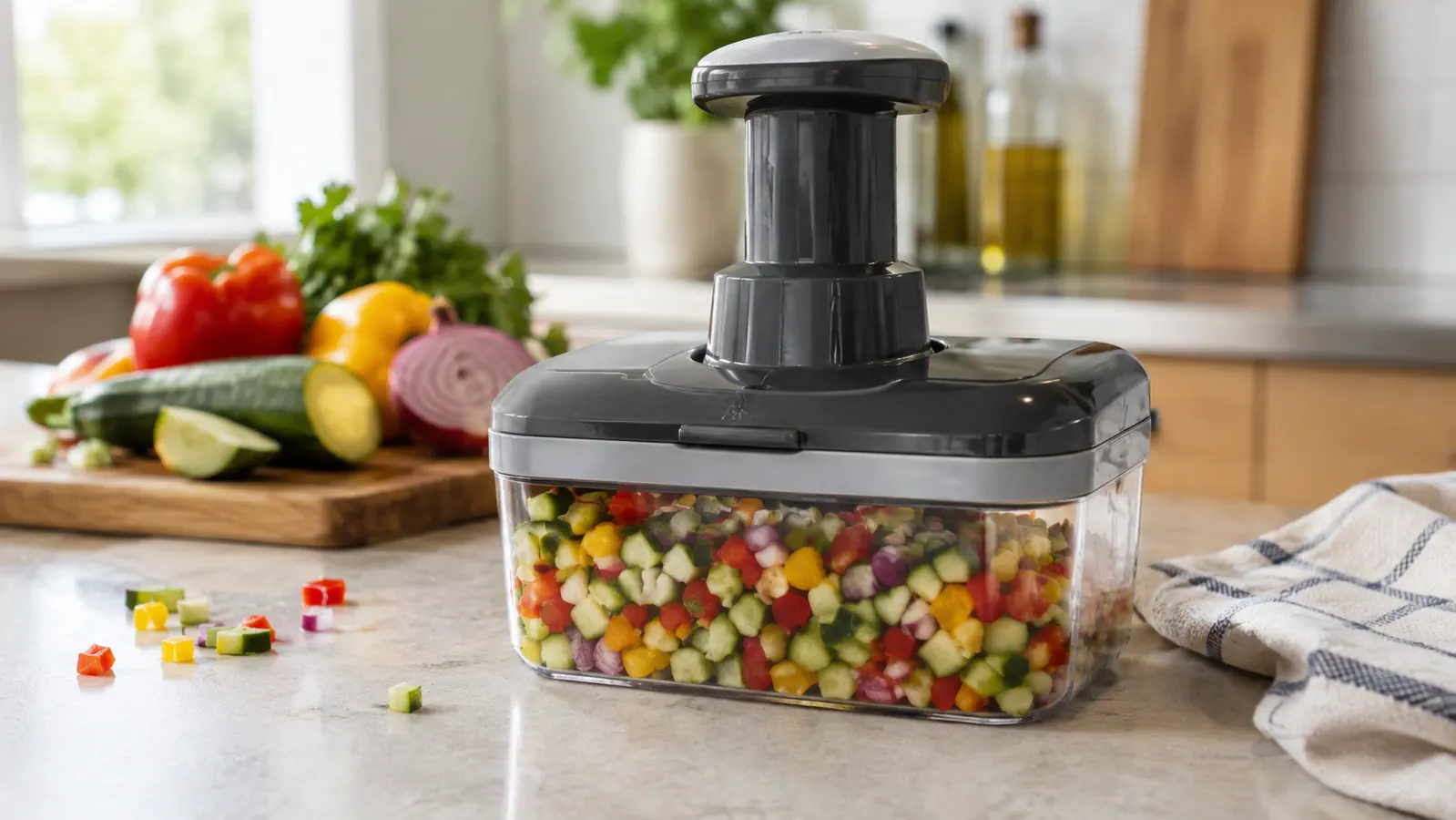
I spent twenty years on a restaurant line, so I respect what a good mandoline can do in the right hands. I also know what happens to most of them in a home kitchen: they end up in a drawer because the guard gets misplaced, the blade asks for a careful touch, and there is never a clean, flat spot to set one up. When my wife Denise asked me to choose a tool that would actually earn its place on our limited counter space here in Hammond, the Fullstar vegetable chopper beat the mandoline for how we cook on a Tuesday night. It is not a clean sweep, and I would not tell anyone to toss a mandoline they already use. But for most home cooks, most nights, the Fullstar does more work with less fuss.
The short answer is this. If you dice onions, shred carrots, chop peppers and spiralize zucchini a few times a week, and you want something our teenage son can use without a lecture about fingertips, buy the Fullstar. If your cooking runs on paper-thin, perfectly uniform slices, the kind a scalloped potato gratin demands every Sunday, the mandoline still does one thing better than any push-down chopper. I have used both for months now, on real weeknight dinners and a big Sunday spread, and I will walk you through exactly where each one wins so you can decide which belongs in your kitchen.
Why These Two Got Compared at All
The reason these two keep getting put in the same sentence is that both promise the same thing: faster vegetable prep with less knife work. I get asked about this more than any other kitchen question, usually by someone who bought a mandoline, used it twice, and now wonders whether the chopper they keep seeing online would be the better tool. The honest answer is that they are not the same tool, and the right choice comes down to what you actually cook more than which one is newer or more popular.
For me, the deciding test was simple. On a night when I am tired, standing at the sink with a bag of onions and thirty minutes to get dinner on the table, which tool do I actually want to pick up? That question settled it faster than any spec sheet, and it is the question I kept coming back to through all of my testing.
Fullstar vs a Mandoline at a Glance
Here is how the two tools stack up after a few months of steady use. I ran both through the same jobs: dicing a yellow onion, shredding carrots for a salad, slicing potatoes for gratin, and spiralizing a couple of zucchini.
| Fullstar Chopper | Mandoline Slicer | |
|---|---|---|
| Best for | Dicing, shredding, spiralizing and everyday weeknight prep | Paper-thin, uniform slices for gratins and salads |
| Slice thickness | Fixed blades from fine dice to medium slices | Dial adjusts from paper-thin to thick |
| Safety | Fingers stay clear of the blades, food drops into the container | Exposed blade, the guard has to be used on every pass |
| Cleanup | Blades and container rinse clean and go in the dishwasher | Guard, blade changes and the base each need attention |
| Storage | A few parts, needs a drawer or a cabinet shelf | Flat and slim, slides into a shallow drawer |
| Versatility | Chops, dices, slices, shreds and spiralizes in one tool | Slices and juliennes, that is the whole job |
| Learning curve | Push down and you are done, almost no technique required | A few tries to get even pressure and a steady hand |
Where the Fullstar Wins
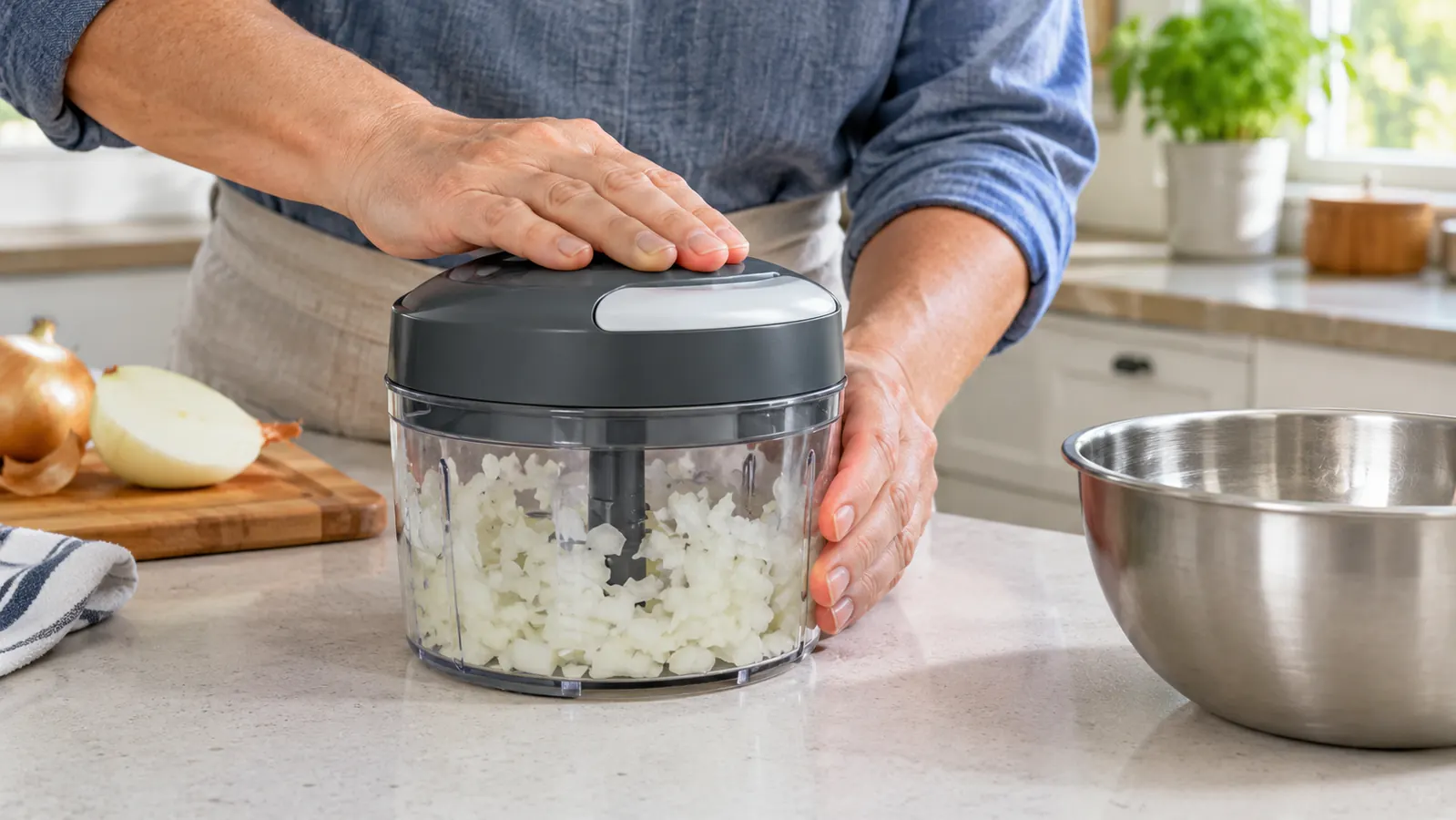
The Fullstar wins on the two things that matter most to a busy home cook: safety and cleanup. On a mandoline, the blade is out in the open and the whole job depends on the hand guard staying between your fingers and the edge. I have seen plenty of line cooks get too confident and pay for it. With the Fullstar, you press the lid down and the food is pushed through the blades into the container underneath. Your hands never go near the cutting edge, which means our son can chop a whole bag of onions without me hovering. After dinner, the blades and the container rinse clean in a minute or two, and the pieces go straight into the dishwasher. The mandoline asks me to take apart the guard, swap blades and wash each piece by hand to protect the edge. Honestly, that ease of cleanup is what keeps me reaching for it, because a tool I dread washing is a tool I stop using.
It also wins on versatility for the way a family actually eats. In one night I have used the Fullstar to dice onions and celery for a pot of gumbo, shred carrots for a slaw, and spiralize a zucchini to fold into pasta so my son eats a vegetable without noticing. The mandoline slices and juliennes, and that is the whole job. If your week involves chopping and shredding more than it involves paper-thin precision, the Fullstar does in one pass what would take three different blades on a mandoline and a fair amount of patience. For the Sunday crowd we host, when I am prepping for eight or nine people, that speed is the difference between being in the kitchen all afternoon and sitting down with a cup of coffee before anyone arrives.
Where a Mandoline Wins
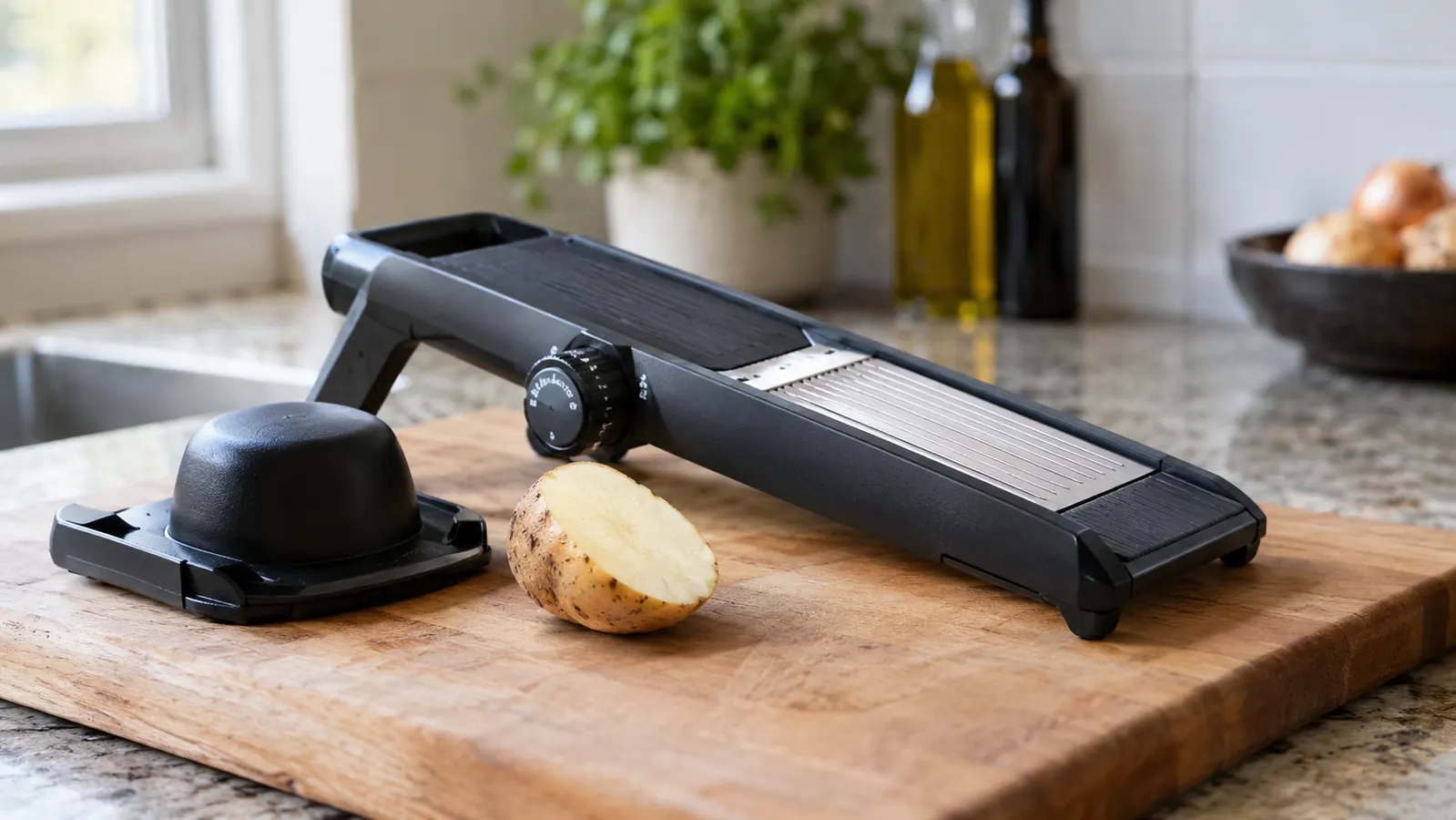
I will be honest, the mandoline wins where thin and even really count. A push-down chopper gives you a consistent dice, but it cannot touch the mandoline for paper-thin, uniform slices. If you make scalloped potatoes, a gratin, a fennel salad sliced translucent thin, or cucumbers for pickles, the mandoline is the tool. You set the dial, run the vegetable across, and every slice comes out the same thickness, which is what makes a gratin cook evenly and look like a restaurant plate. I have tried to get that result from the Fullstar's slicing blade, and it gives a perfectly good medium slice, just not the tissue-thin cut a mandoline produces without effort. That even thickness matters more than people expect. It changes how a dish cooks, not just how it looks.
The mandoline also wins on storage and on the price of entry, though I am not quoting numbers here. It is a flat, slim board that slides into a shallow drawer and takes up almost nothing. The Fullstar is a few parts and needs a drawer or a cabinet shelf of its own, which matters in a kitchen like ours where counter space is the scarcest thing I own. If you already own a mandoline that you actually use, keep it. Buy the Fullstar to cover the chopping, dicing and shredding, and let the mandoline stay in the drawer for the Sunday gratin. The two tools are not rivals so much as they are two jobs that happen to live in the same kitchen.
Want one tool that chops, dices, shreds and spiralizes? This is it.
The Fullstar vegetable chopper has earned its spot on my counter because it does the everyday work without the guard, the blade changes and the careful touch a mandoline asks for. If your weeknight prep is more chopping than thin slicing, this is the tool to start with. See today's price on Amazon and decide for yourself.
Amazon Check Today's Price on Amazon →How I Tested Both
I ran both tools through the same five jobs over a few weeks. I diced a yellow onion, shredded a bag of carrots, chopped three bell peppers for a Sunday chili, sliced two russet potatoes for gratin, and spiralized zucchini for pasta. I timed each job, counted the cleanup steps, and paid attention to how I felt reaching for each tool on a tired Tuesday night. There is a longer account of how the Fullstar holds up over months of use in my long-term review, and a separate piece on the ten ways it saves weeknight prep time, both of which go deeper than I can fit here.
The clearest difference showed up in how often each tool came out of the drawer. In three weeks I reached for the Fullstar fourteen times and the mandoline twice, once for the potato gratin and once to slice fennel for a salad. The mandoline did exactly what I needed those two nights, and it did it beautifully. The other fourteen nights it would have been the wrong tool, or at least the more fiddly one. That is the honest math of it. A tool only saves you time if you actually use it, and the one you reach for is the one that earns the drawer space. The mandoline is a precision instrument and I respect that. The Fullstar is a workhorse, and a workhorse is what a weeknight needs.
Safety was part of the test too. I had our son use the Fullstar on his own after a single demonstration, and he turned out a whole bowl of diced onion without a moment of hesitation. I would not hand him a mandoline with the same confidence. That alone decided a lot for me, because a tool the whole household can use is a tool that actually gets used.
Who Should Buy Which
Buy the Fullstar if you cook from whole vegetables most nights and you want the prep done in one pass with nothing to disassemble carefully. It suits anyone who dices onions and peppers for sauces, shreds carrots and cabbage for slaw, or wants to spiralize vegetables so the family eats more of them. It also suits a household where more than one person cooks, because there is almost no way to hurt yourself on it and no technique to explain. If you have limited counter space like we do, this is the tool that replaces several single-purpose gadgets and frees up the drawer they used to fill.
Keep a mandoline, or buy one, if your cooking is built on thin, uniform slices and you already have a safe habit with the guard. Gratins, pickles, shaved salads and anything that needs to cook evenly at a precise thickness are its home turf. If that describes your Sunday cooking, the mandoline earns its spot. But if you are choosing one tool for a small kitchen and your week looks more like chili, stir-fry and slaw than French gratin, the Fullstar is the more honest answer. You can always add a slim mandoline later for the thin-slicing jobs, and the two will live happily in the same drawer, mostly because the Fullstar will be the one you pull out every night.
If you are still torn, use the vegetable test. Grab whatever you prep most often, an onion, a carrot, a potato, and picture the finished piece you actually want. If you want a clean dice and shreds, the Fullstar gets you there in one push. If you want a paper-thin round that cooks evenly in a cream sauce, the mandoline is your tool. Most home cooks want the first thing most nights, and that is why the Fullstar has earned the permanent spot on my counter.
The tool you actually reach for is the one that saves you time. In my kitchen, that has been the Fullstar almost every night.
Whatever you choose, the win is getting more vegetables into dinner without treating prep like a chore. That is the whole point of either tool, and both of them do it. My money and my drawer space went to the Fullstar because it does the job more often and asks less of me on the nights I need the most help.
Start with the tool that does the everyday work.
The Fullstar vegetable chopper covers the dicing, shredding and spiralizing that make up most of my weeknight prep, and it cleans up in minutes. If that sounds like your kitchen, check today's price on Amazon and see if it earns a spot on your counter the way it did on mine.
Amazon Check Today's Price on Amazon →