
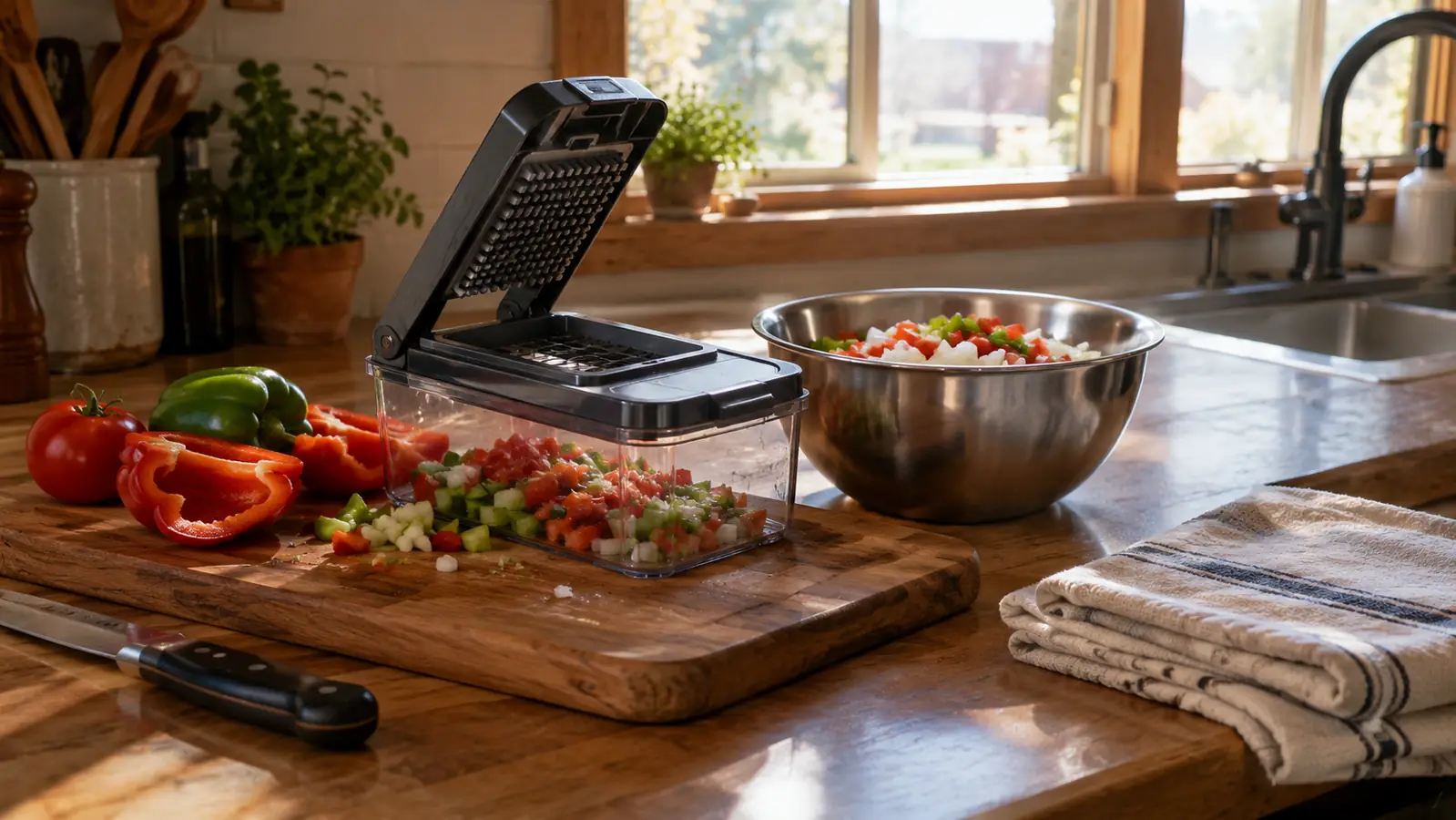
Let me start with the honest part: I did not want to like this chopper. I spent years on a restaurant line, and I learned to do most prep work with a knife. When my wife Denise brought home a Fullstar vegetable chopper and said it would save me time on weeknights, I nodded the way you nod when you are pretty sure a gadget is about to take up drawer space. Then I used it on a Tuesday dinner, and I had to change my mind. That first night I chopped an onion, two bell peppers, and a handful of mushrooms in about two minutes, and the pieces came out more uniform than anything I did by hand. It is the kind of tool that makes you wonder why you spent years doing it the hard way.
The Fullstar Pro Original Vegetable Chopper and Spiralizer has been on our counter for a few months now, and it has earned a permanent spot. That is not the same as saying it is perfect. There are things I wish someone had told me before I started using it, mostly about how to load it, how to clean it, and which jobs it should never do. This review is the stuff I figured out the hard way, written for a home cook who wants an honest answer about whether this gadget is worth the counter space. I am not going to tell you it replaces your knives, because it does not. I am going to tell you exactly where it helps and where it gets in the way. And I will tell you the parts that might make you leave it in the cabinet, because you deserve to know those before you buy.
The Quick Verdict
A genuinely useful prep tool for home cooks who chop onions, peppers, and potatoes most nights. It is not a knife replacement, and cleanup takes longer than the ads suggest, but for speed and consistency on busy weeknights it earns its counter space.
Amazon Check Today's Price →The Fullstar chopper that stays on my counter
If you want the short version, here it is. This is the chopper that stays on my counter. It handles the nightly onion, pepper, and potato work faster than I can do it with a knife, and the built-in container means I am not chasing diced vegetables across the cutting board. It has limits, and I list them below, but for the everyday grind of weeknight cooking it has been the most useful gadget in my kitchen. Check the current price on Amazon and see if it fits the way you cook.
Amazon Check Today's Price on Amazon →How I've Used It
Most of my testing happened on real weeknight dinners, not staged prep sessions. Over the past three months I have used the Fullstar chopper for onions, bell peppers, celery, carrots, zucchini, tomatoes, mushrooms, and potatoes. I also ran it through the spiralizer attachments for zucchini noodles and carrot ribbons, mostly because my teenage son decided he liked 'zoodles' for about two weeks. Every single test was part of an actual dinner, which means I got to see how the chopper behaves when you are tired, hungry, and in a hurry. I have also used it for a quick pico de gallo, and the results were better than my knife work on a busy night.
Weeknights in our house are a three-person operation. Denise handles the protein, I handle the vegetables, and our son sets the table. That means my prep window is usually fifteen minutes, and the chopper has to earn its place in that window. On most nights it does. A large onion goes from whole to diced in about twenty seconds, and the even pieces cook at the same rate, which matters more than most home cooks realize. When the onion is already diced before the pan is hot, you stop rushing and start cooking. Denise uses it too, which is the highest compliment a kitchen tool gets in our house.
I also took it to a Sunday dinner when the family crowd was bigger. I prepped a full tray of vegetables for roasting, and the chopper handled the volume without complaint. The container holds a decent amount, so I emptied it a few times, but the rhythm was faster than knife work for that quantity. I did have to stop and rinse the blades between batches, which is worth knowing if you are cooking for a crowd, but the overall time was still better than standing over a cutting board. The chopper does not mind being the workhorse.
What It Does Well
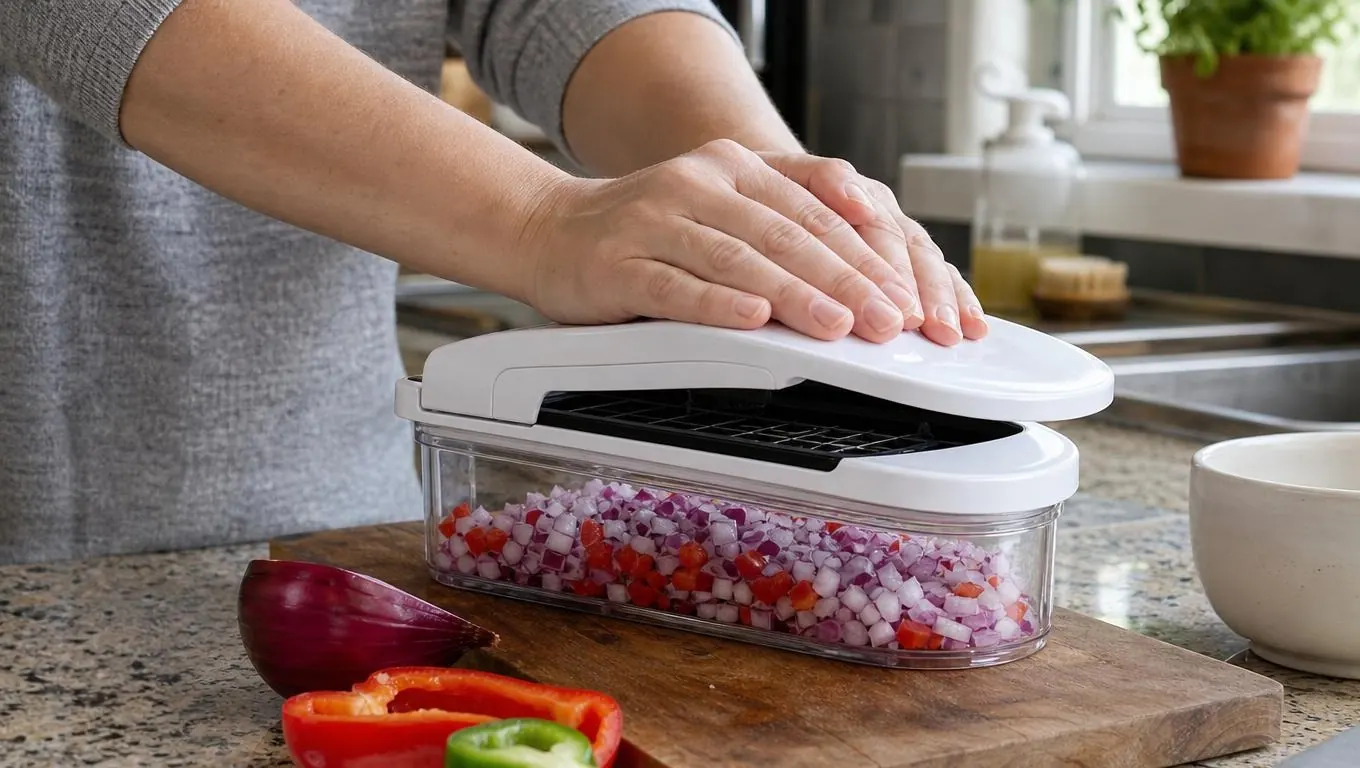
The biggest surprise was consistency. When I dice an onion by hand, I get a mix of sizes, and the smaller bits burn while the larger pieces are still raw. The Fullstar chopper pushes everything through the same grid, so you get uniform pieces every time. For soups, stews, and skillet dinners, that even cooking is the real benefit. It is not about saving five minutes. It is about the whole dinner cooking at the same rate, so the onions are soft and sweet instead of half raw and half scorched. That alone has made our Tuesday taco night faster and better.
The second strength is the built-in container. Most choppers I have tried over the years required me to chop into a bowl, then transfer, then wash the base and the bowl and the lid. This one collects the chopped food in the container underneath, so I dice a pepper, slide the container out, and dump it straight into the pan. Fewer dishes matters in a kitchen with limited counter space. When you only have a small stretch of counter between the sink and the stove, every extra bowl you do not have to wash is a small victory. I have washed that container more times than I can count, and it still looks new.
The interchangeable blades are easy to swap. The chopper comes with a few different cutting grids, and switching between them takes seconds. I mostly use the medium dice for weeknights and the finer grid when I am making a mirepoix for a Sunday pot. The spiralizer attachments are not something I reach for daily, but they work well enough for zucchini noodles and carrot ribbons. The whole thing feels solid in the hand, and after months of use, nothing has cracked or warped. The blades are sturdy enough that I stopped worrying about bending them.
What Nobody Tells You
Here is the part the ads leave out. You have to push food through the grid, and that means you are pressing down with the lid. If you load the chamber too full, the food squirts out the sides. I learned this the hard way with a tomato that ended up on the counter, the floor, and my apron. The fix is simple: cut larger vegetables into chunks that fit the chamber, and do not overfill. Once I did that, the mess stopped. Now I load the chamber about three quarters full and press steadily instead of slamming down. It is one of those lessons you only learn by making the mess.
Cleanup is also not as fast as the marketing suggests. The blades come out, and you do need to rinse the grid and the container after each use. If you chop something starchy like potatoes, the residue dries quickly and takes a little scrubbing. It is not a difficult cleanup, but it is not the 'rinse and done' claim you see in the ads. I have found that rinsing everything immediately after use makes a big difference. If you let it sit, you will be scrubbing. If you rinse it while you are waiting for the pan to heat, it is a thirty second job. That is the honest truth, and it is the answer to the question everyone asks.
The other thing nobody tells you is that the chopper works best on firm vegetables. Soft things like ripe tomatoes and cooked potatoes can turn mushy if you push too hard. I still use a knife for those. For onions, peppers, carrots, celery, and raw potatoes, the chopper is excellent. Knowing which jobs belong to which tool is the difference between loving this gadget and throwing it in a drawer. Once I matched the tool to the job, my frustration disappeared. A knife is faster for those jobs anyway.
The first week was not all smooth. I tried to chop a whole onion without cutting it first, and it wobbled around the chamber. I tried to spiralize a carrot that was not centered, and I got a stubby mess. I also pressed down so hard on a sweet potato that the pusher lid flexed and a chunk shot out sideways. None of these were the product failing. They were me using it the way I would use a knife, and this tool wants different habits. Once I learned the rhythm, everything changed. Cut the vegetable into chunks that fit the chamber. Fill the chamber about two thirds full. Press down with steady, even pressure. Empty the container before it gets packed too tight. That is the whole method. You will not need to read the manual twice.
Where It Falls Short
The spiralizer is the weakest part of the package. It works, but it takes some practice to get a clean spiral. The vegetables need to be centered, and you have to apply steady, even pressure. My first few attempts at zucchini noodles came out lopsided. Once I got the hang of it, the results were fine, but I would not buy this product just for the spiralizer. It is a bonus attachment, not the main event. If spiralized vegetables are the main reason you are looking, a dedicated spiralizer is a better choice. I say that as someone who genuinely likes kitchen gadgets.
The chopper is also a bit bulky. It is not huge, but it does take up a corner of the counter, and if you have very limited space, you will need to decide whether it earns that spot. In our kitchen, it does, because we use it most nights. If you only cook a few times a week, it might be better stored in a cabinet. I keep ours on the counter because out of sight means out of mind for me, and I want it to be the default tool when I start dinner. Measure your counter before you buy.
One more honest note: the pusher lid has some flex to it. It is not flimsy, but it is plastic, and if you press down hard on a dense vegetable like a sweet potato, you can feel it give a little. I have not broken anything in months of use, but I would not recommend this for someone who expects to power through whole vegetables without cutting them first. Chunk everything first and it will last. The blades stay sharp, the container has not stained, and the whole thing still looks the way it did the day Denise brought it home. That is the only real durability concern I have after months of use.
How It Compares to the Alternatives
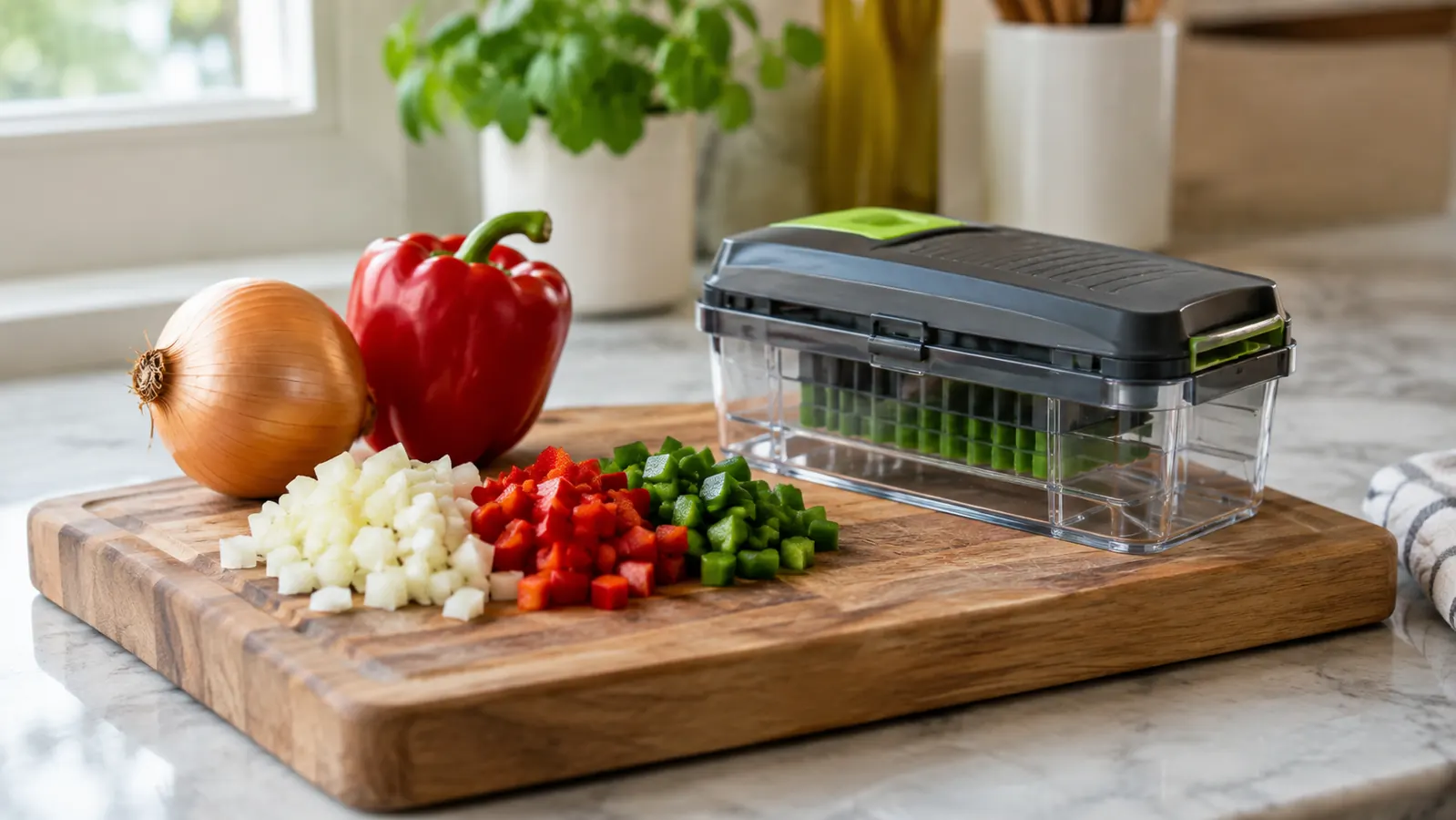
I have owned a few mandoline slicers over the years, and the Fullstar chopper is a different tool. A mandoline gives you thin, even slices and does it quickly, but it scares me a little every time I use it because the blade is exposed. The chopper is safer, since the blades sit inside the container and your hands stay on the lid. For anyone who has ever nicked a finger on a mandoline, that safety difference is worth something. The tradeoff is that a mandoline slices while this chopper dices, so they are not really competing for the same job. The mandoline lives in a drawer now.
I also tried a classic manual food chopper with a pull cord. It worked fine for small batches, but it struggled with larger quantities, and the cord mechanism felt like it would break eventually. The Fullstar chopper handles volume better and feels sturdier. It is not a food processor, though. If you need to shred a whole head of cabbage or puree a soup, a food processor is the right tool. The chopper is for the everyday dice and chop work, and for that job it beats every manual tool I have owned. We pull the food processor out maybe once a month.
What I Liked
- Uniform dice that cooks evenly
- Built-in container means fewer dishes
- Interchangeable blades swap in seconds
- Safer than a mandoline for most prep
- Holds up to regular weeknight use
Where It Falls Short
- Cleanup takes longer than the ads suggest
- Soft vegetables can turn mushy if overfilled
- Spiralizer takes practice to get right
- Bulky enough that counter space matters
- Pusher lid flexes on very dense vegetables
The real benefit is not saving five minutes. It is the whole dinner cooking at the same rate.
Who This Is For
This chopper is for the home cook who preps vegetables most nights and wants even pieces without dragging out a food processor. If you make soups, stews, skillet dinners, or sheet pan meals, and you are tired of onions that cook unevenly, the Fullstar chopper will earn its place. It is also a good fit for anyone with limited knife skills who wants consistent results quickly, and for cooks who want a safer alternative to a mandoline. If you cook for two or three people most nights, the size is just right. If that sounds like your kitchen, this is worth a look.
Who Should Skip It
Skip this if you are a confident knife cook who enjoys prep work and has the counter space for a large cutting board. If you rarely cook with fresh vegetables, or if you mostly cook for one, the chopper might not justify its footprint. And if you are looking for a spiralizer first and a chopper second, I would look at a dedicated spiralizer instead. The Fullstar is a chopper with a spiralizer bonus, not the other way around. There is no shame in admitting you will use the chopper part every day and the spiralizer part twice a year. Both answers are fine, and knowing yours before you order will save you the return trip.
The chopper that survived three months of weeknights
If your kitchen is anything like mine, you do not have room for gadgets that only work once. This one has stayed on my counter since the first Tuesday I used it. It chops evenly, it collects the food in its own container, and it is honest about its limits. The learning curve is short, the cleanup is manageable, and the results are consistent night after night. See the current price on Amazon and decide if it deserves a spot in your kitchen.
Amazon Check Today's Price on Amazon →