
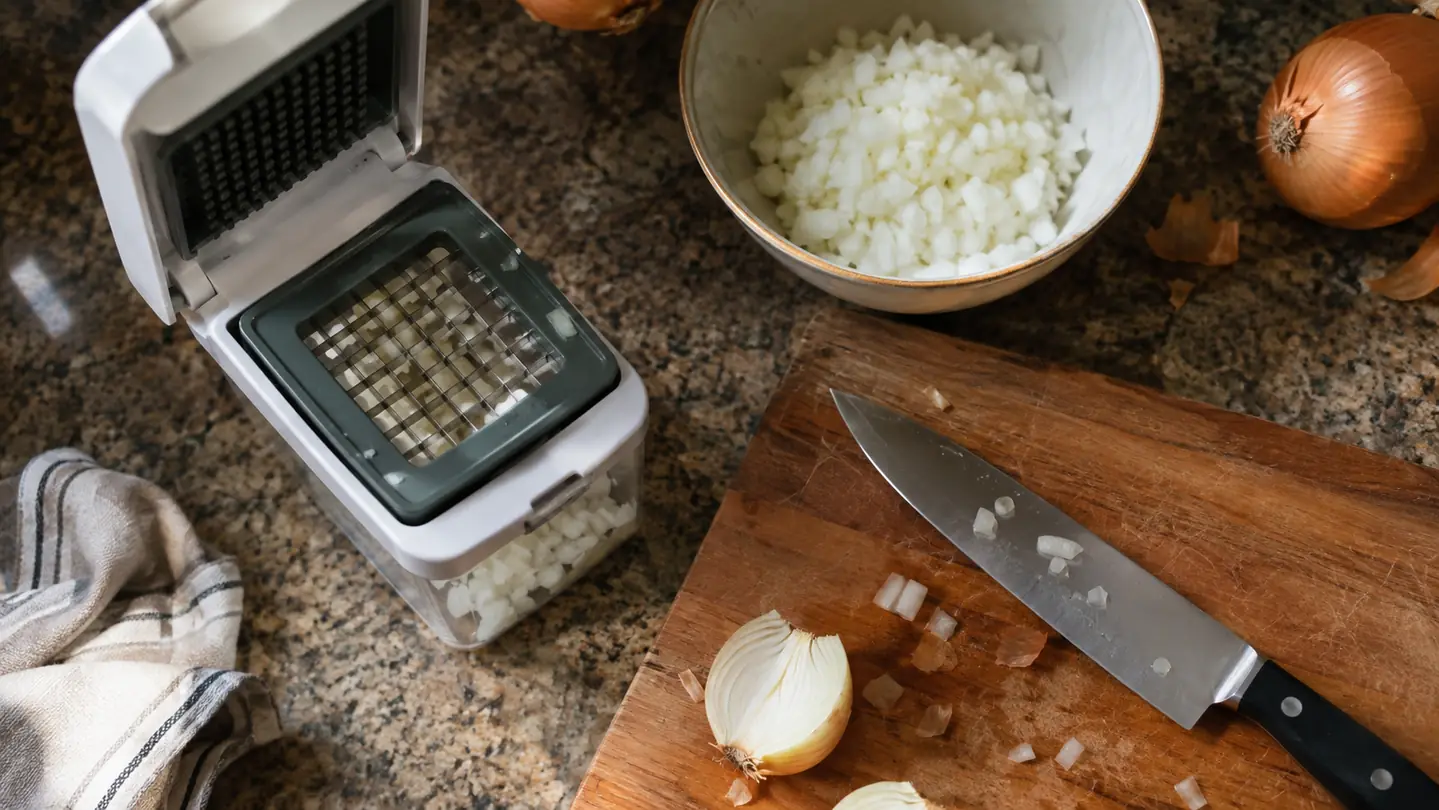
On a weeknight, I have about forty-five minutes between getting home and getting dinner on the table. That was before I got serious about meal prep. For years, I'd stand at the counter with a chef's knife, dicing an onion, seeding a pepper, slicing mushrooms, wondering why a simple stir-fry took so long. The knife work felt like the slow part. It turns out the slow part wasn't the cooking. It was the chopping. The same onion that takes thirty seconds with the right tool takes me three minutes with a knife, and those minutes add up fast when you're feeding three people on a Tuesday.
Fullstar's Pro Original Vegetable Chopper is the tool that changed that math for me. It's not a replacement for every knife in the drawer. But for the daily grind of onions, peppers, celery, and zucchini, it turns a fifteen-minute prep job into a five-minute one. I've been using mine for a few months now, and I've settled into a routine that cuts my total prep time about in half. The key was learning to use it the right way. It doesn't work like a food processor or a mandoline. It works best when you feed it vegetables cut to the right size, press down with steady pressure, and then move on to the next piece. Once you get the rhythm, it becomes as natural as picking up a knife.
Get the Fullstar Pro Original on Amazon
If you're tired of the same slow knife work every night, the Fullstar chopper is the shortcut that actually holds up. See today's price and read the full specs before you decide.
Amazon Check Today's Price on Amazon →Step 1: Set Up Your Counter and the Chopper
Before a single vegetable gets cut, set yourself up so the chopper doesn't slide around. I use a damp kitchen towel folded under the base. That little trick keeps the chopper planted while you press down. On my Formica counter, it's the difference between controlled cuts and the whole unit skating toward the sink. If your counter is slick or you're working on a smaller table, the towel is not optional. It also catches any juice that drips, which means less cleaning later.
Have a large cutting board on one side and a big mixing bowl on the other. The Fullstar comes with a container that fits under the blades, so diced onion lands right in the cup. I keep that cup close and dump it into a larger bowl between batches. The less you move food around, the faster the job goes. I also set out a paper towel for wiping the blade between different vegetables especially if I'm going from onion to apple or something sweet. A quick wipe prevents flavors from carrying over.
The setup should take two minutes, not ten. If you're sorting through drawers or hunting for the lid, you're not saving time. I keep the Fullstar and its accessories in a drawer right next to the sink, where I can grab it without a search. The unit is compact enough that it doesn't crowd the drawer, which is one of the reasons it earned a permanent spot in my kitchen.
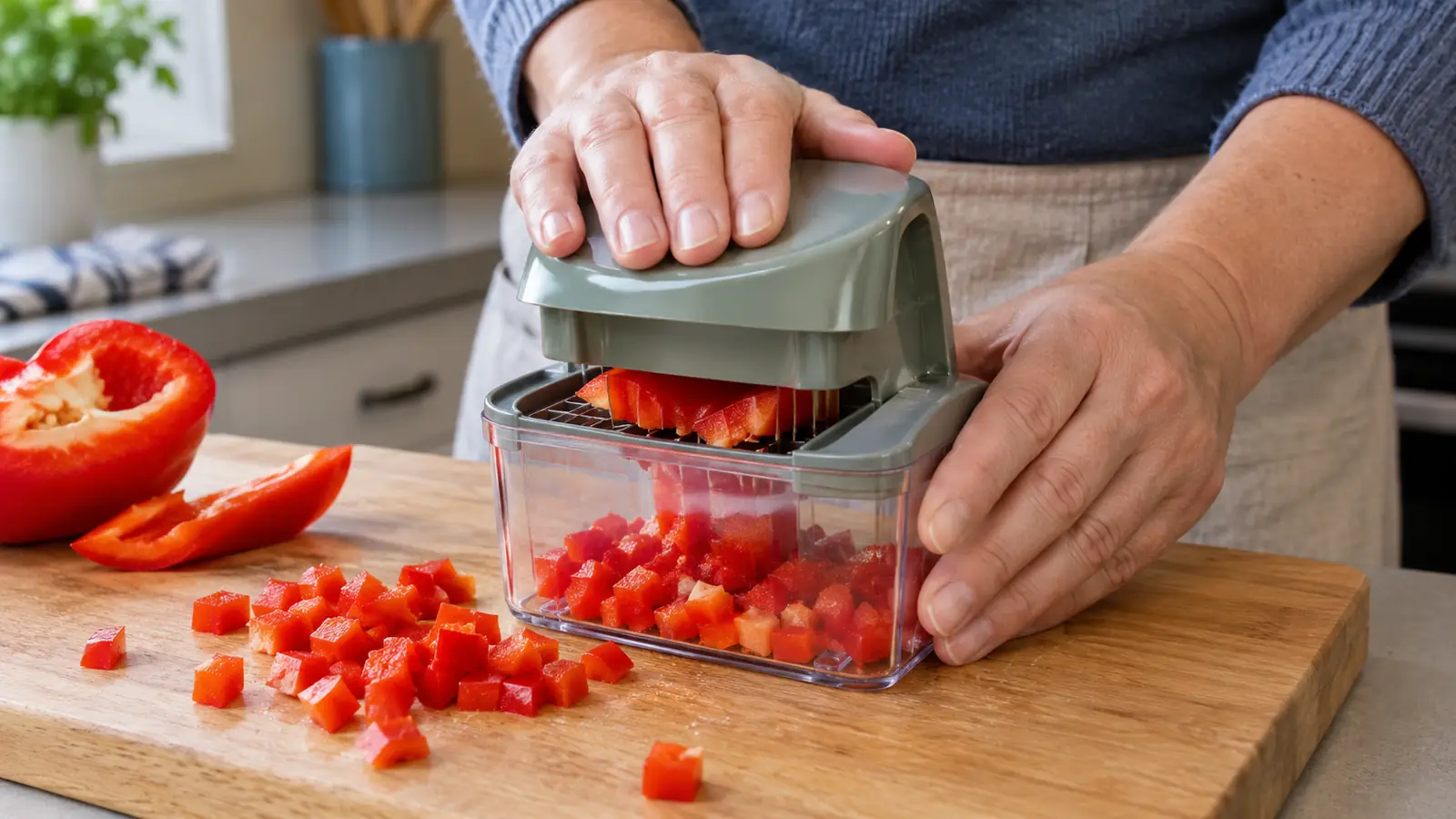
Step 2: Chop the Heavy Vegetables First
Start with the vegetables that take the most knife time: onions, bell peppers, celery, carrots. Those are the ones that make you set down your knife, wipe your eyes, and start over. With the Fullstar, you cut the onion into a few wedges that fit the feed chute, push down, and you have dice in one press. Same for a pepper: cut it into flat strips, stack them, and press. The action is quick and repetitive, which is exactly what you want when you're prepping a week's worth of vegetables.
I run the onion through once for a medium dice. For minced, I give the pieces a second pass. That's something I can't do with a mandoline without slicing a fingertip. Because the Fullstar is a chopper, you control the fineness by how many times you push. That control is why it beats a knife for speed and a mandoline for safety. And because the blades are contained, there's no chance of a slippery pepper sliding off the board and onto the floor.
Don't overload the chopper. It's tempting to shove in three onion wedges at once to save a pass, but you'll end up with uneven pieces and a jammed unit. I learned that the hard way. One or two wedges at a time gives a clean, even dice. If you have a big batch, that's fine. The chopper processes quickly enough that a few extra passes won't cost you more than a couple of minutes.
Step 3: Spiralize the Long Vegetables While You Have the Tool Out
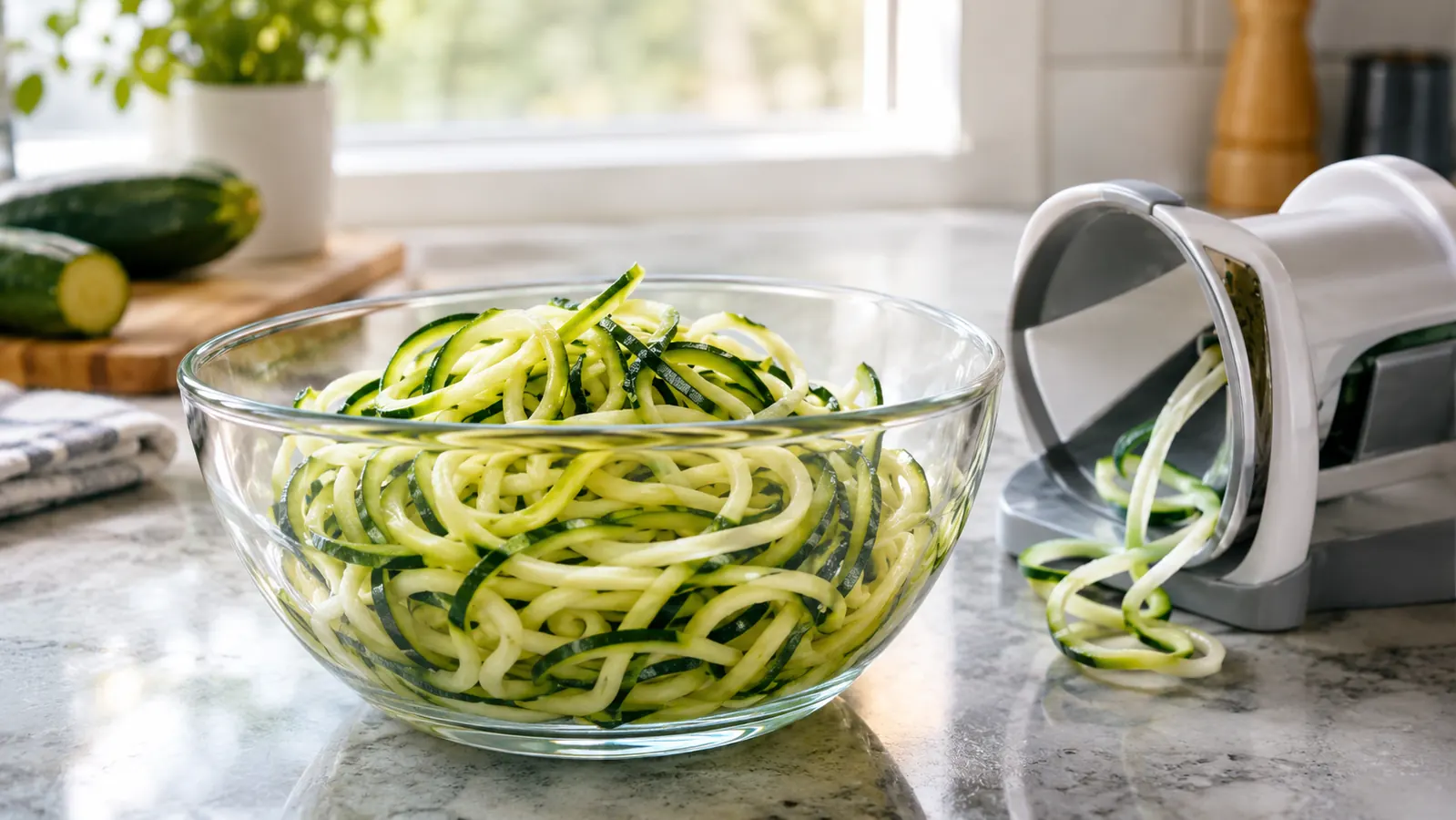
Once the chopping is done, I swap blades and spiralize zucchini, carrots, or squash. The Fullstar includes a spiralizer attachment, so I don't need a separate gadget taking up drawer space. A few turns and I have noodles for a quick veggie stir-fry or a batch of zoodles for lunch. The spiralizer fits on the same base, so I don't have to clear a second setup. It's the same motion as sharpening a pencil, and it's easy on the wrists.
This is the step where people tell me they'd just use a peeler. You can, but a peeler gives you ribbons, not noodles, and it's slow if you're doing more than one zucchini. The spiralizer on the Fullstar is fast and keeps the vegetable whole, so the texture stays. It rinses clean with a brush and doesn't take up a whole drawer, which matters when counter space is tight. I've compared it side-by-side with a dedicated spiralizer in my kitchen, and the Fullstar's attachment does the job without the extra bulk.
One note on spiralizing: trim the ends of the vegetable so they're flat. That gives you a better grip on the handle and prevents the vegetable from wobbling. If you're spiralizing carrots, peel them first. The blades handle the texture fine, but the peel can leave a bitter edge. Zucchini doesn't need peeling. Just trim, push, and turn.
Step 4: Build a Container System for the Prepped Vegetables
The fastest way to lose your meal-prep gains is to chop everything and then not have a place to put it. I use a few glass containers with lids. One for diced onion, one for pepper strips, one for shredded carrots. When I'm ready to cook, I pull out the container I need instead of starting from scratch. This is the system that finally stuck for me. Before that, I was chopping individual ingredients every night, which defeated the whole purpose.
The Fullstar's cup works well as a prep bowl, but for larger batches I transfer to quart containers. If you're only prepping for a day or two, the included cup is enough. For a Sunday batch, use the bigger system. Either way, the point is to keep the prepped vegetables visible so you actually use them. Out of sight, they rot in the back of the fridge. I label each container with a piece of tape and a marker. It takes five seconds and saves me from playing fridge roulette later.
If you're new to meal prep, start with just two or three vegetables. Don't try to prep the entire produce aisle. The goal is to make Tuesday easier, not to build a restaurant prep line. Once you see how nice it is to have diced onion waiting, you'll naturally want to add more. The Fullstar makes it easy to scale up, but the container system is what keeps it organized.
Step 5: Cook Three Meals From One Prep Session
This is where the time saving becomes real. On a Sunday, I chop a big batch of onions, peppers, and celery, plus a couple of zucchini noodles. That gives me the base for Monday's stir-fry, Tuesday's chili, and Wednesday's frittata. Everything is ready in the containers, so dinner is mostly assembly. I'll brown some ground turkey and toss it with the prepped vegetables, or I'll throw the zoodles into a hot pan with a little oil and garlic.
I've done this with the Fullstar for chicken stir-fry, turkey tacos, and a big pot of vegetable soup. The chopper doesn't do the cooking, but it removes the bottleneck that used to make me order takeout on busy nights. I'm not a meal-prep perfectionist. I don't spend all Sunday afternoon on it. I prep for about thirty minutes, and the payoff is three weeknights where dinner is on the table by six thirty. The chopper has also earned a place in my Sunday routine because it does the job without making a mess I have to scrub for another ten minutes.
One thing I've learned is to keep the same base vegetables. When I try to prep three totally different meals, the prep takes twice as long. If I'm making chili, frittata, and stir-fry, they all share onions and peppers. I prep the shared ingredients in bulk. The rest I prep only what's unique to each recipe. That cuts the knife work down to a single common batch instead of three separate ones.
If you're trying to decide between the Fullstar and a mandoline slicer, the [comparison](/fullstar-vegetable-chopper-vs-mandoline-slicer) on this site breaks down where each one earns its place. And for a longer look at how the Fullstar holds up month after month, the [long-term review](/fullstar-vegetable-chopper-review-long-term) covers blade wear and build quality in more detail.
What Else Helps
A few things that aren't the Fullstar but make the whole routine better: a bench scraper to move chopped vegetables off the cutting board, a set of nesting mixing bowls, and a big cutting board with a lip. The chopper does the work, but these add up to a smoother flow. None of them cost much, and they all earn their drawer space. A bench scraper is underrated. It lets you scoop up a pile of diced onion in one go instead of dragging them across the board with your hand. I also like having a small spray bottle of vinegar and water nearby for wiping the chopper between uses.
Another helper is a timer. I set mine for twenty minutes when I start prepping. When it goes off, I stop, even if there's a little left. That keeps me from turning a quick prep into an afternoon project. The Fullstar is fast, but the timer reminds me not to get fiddly. I'm not trying to enter a precision-chopping contest. I'm trying to get dinner on the table.
The biggest time saver of all might be cleanup. One unit does the dicing and the spiralizing, so you're not washing three gadgets at the end of the night. Rinse the blades, wipe the base, and you're done. That matters as much as the chopping itself.
On a normal Tuesday, I went from forty-five minutes of knife work to about twenty, and the kitchen looked better at the end.
Make Weeknights Faster Starting Tonight
The Fullstar Pro Original is one of the few kitchen tools I'd buy again without thinking. It saves time, takes up minimal space, and makes meal prep feel less like a chore. Check today's price on Amazon and see if it fits your counter.
Amazon Check Today's Price on Amazon →