
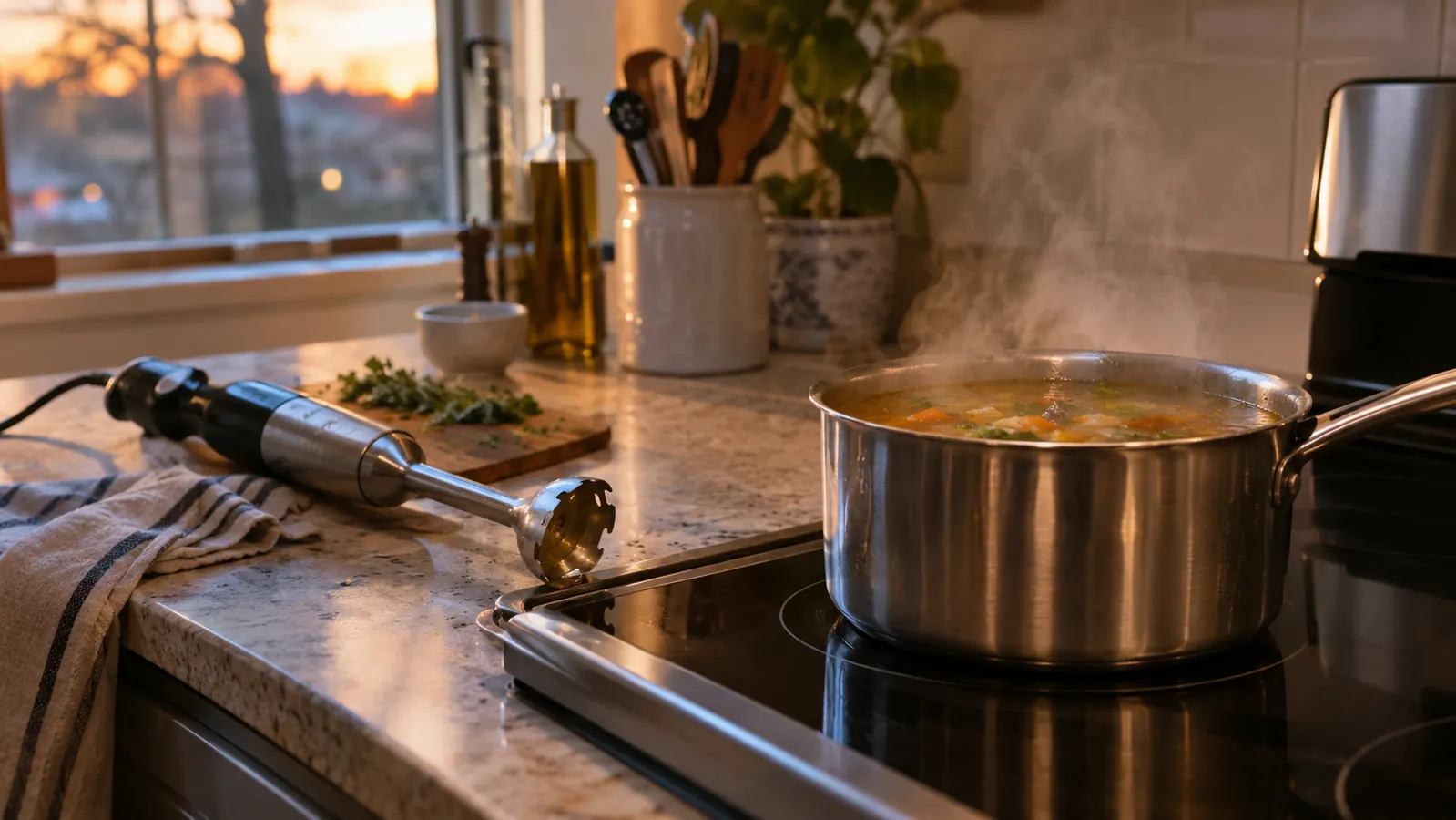
I have owned a full-size countertop blender for years, and I have also owned a KitchenAid hand blender for the last two winters. If you had asked me six months ago which one I would keep if the other had to go, I would have said the countertop blender without hesitating. Ask me today and the answer has flipped. That is not because the hand blender is more powerful, because it is not. It is because the hand blender fits the way I actually cook on a Tuesday night, and the countertop blender fits the way I think I should cook.
Here is the short version. The KitchenAid hand blender takes up a single drawer instead of a square foot of my counter, it cleans up in about twenty seconds, and it handles most of the blender jobs a home cook faces in a normal week. The countertop blender still wins for crushing ice, frozen fruit smoothies, and big Sunday batches. For everything else, the hand blender is the one I reach for. Both have a place in a full kitchen. Most people only have room for one, and for a small kitchen, the hand blender is the better bet.
How I Tested Both
I cook dinner at home most nights for my wife Denise, our teenage son, and myself in Hammond, Louisiana, and I came up in restaurant kitchens, so I am picky about how a blender handles. My weeknights are small-batch cooking: a pot of tomato soup, a sauce for pasta, a single smoothie before work, a quick gravy for rice. On Sundays the crowd grows and I make a big batch of gumbo or a pot of red beans, and that is where a full-size blender earns its keep. I ran both blenders through the same jobs, weeknight and Sunday, for a couple of months before I let myself have an opinion.
The hand blender went through tomato soup, hollandaise, marinara, a batch of smoothies for three, and a few milkshakes for the teenager. The countertop blender handled the same soups in big batches, crushed ice for frozen drinks, and pureed a whole pot of red beans without complaint. I also timed cleanup for both, because cleanup is where blenders actually go to die. A blender that is a pain to wash is a blender that stays in the cabinet, and I wanted to know which one I would actually keep reaching for.
| KitchenAid Hand Blender | Countertop Blender | |
|---|---|---|
| Counter space | Fits in a drawer or a cup holder | Needs a permanent spot on the counter |
| Blend in the pot | Puree soup right in the pot it cooked in | Must transfer hot liquid to the pitcher first |
| Cleanup | Rinse the shaft under the tap, about twenty seconds | Wash the pitcher, lid, and sometimes the blade base |
| Storage | Fits flat in a deep drawer | Often lives on the counter year round |
| Buy-in | Lower cost to get started | Higher cost for the same weeknight jobs |
| Power | Plenty for soups and sauces, lighter for frozen fruit | Crushes ice and handles frozen fruit easily |
| Batch size | Best for one to four servings | Handles a gallon in two batches |
| Hands-free | You hold it the whole time | Set it and walk away while it runs |
| Best for | Weeknight soups, sauces, single smoothies | Frozen drinks, big batches, heavy blending |
Where the KitchenAid Hand Blender Wins
The biggest win is the counter. My kitchen is in a 1990s ranch house with exactly one usable stretch of counter between the range and the sink, and the countertop blender lives there permanently. That means I am always shuffling it aside to chop vegetables, roll out dough, or set down a cutting board. The hand blender lives in a drawer. When I need it, it is out and back in thirty seconds, and when I do not need it, it is out of my way entirely. That single difference changed which one I grab for weekday cooking more than anything else.
The second win is cleanup. After a weeknight soup, I rinse the hand blender shaft under the tap for a few seconds, wipe the cord, and put it away. That is the whole job. The countertop blender means washing the pitcher, the lid, and sometimes the blade assembly, and my pitcher does not fit flat in the sink, so it becomes a whole production. On a Tuesday night after a full day of work, that production is the difference between making a blended soup and making something that needs no blender at all. I am a grown man who has washed a lot of kitchen equipment, and I will tell you plainly that I skip the countertop blender many nights just to avoid the cleanup.
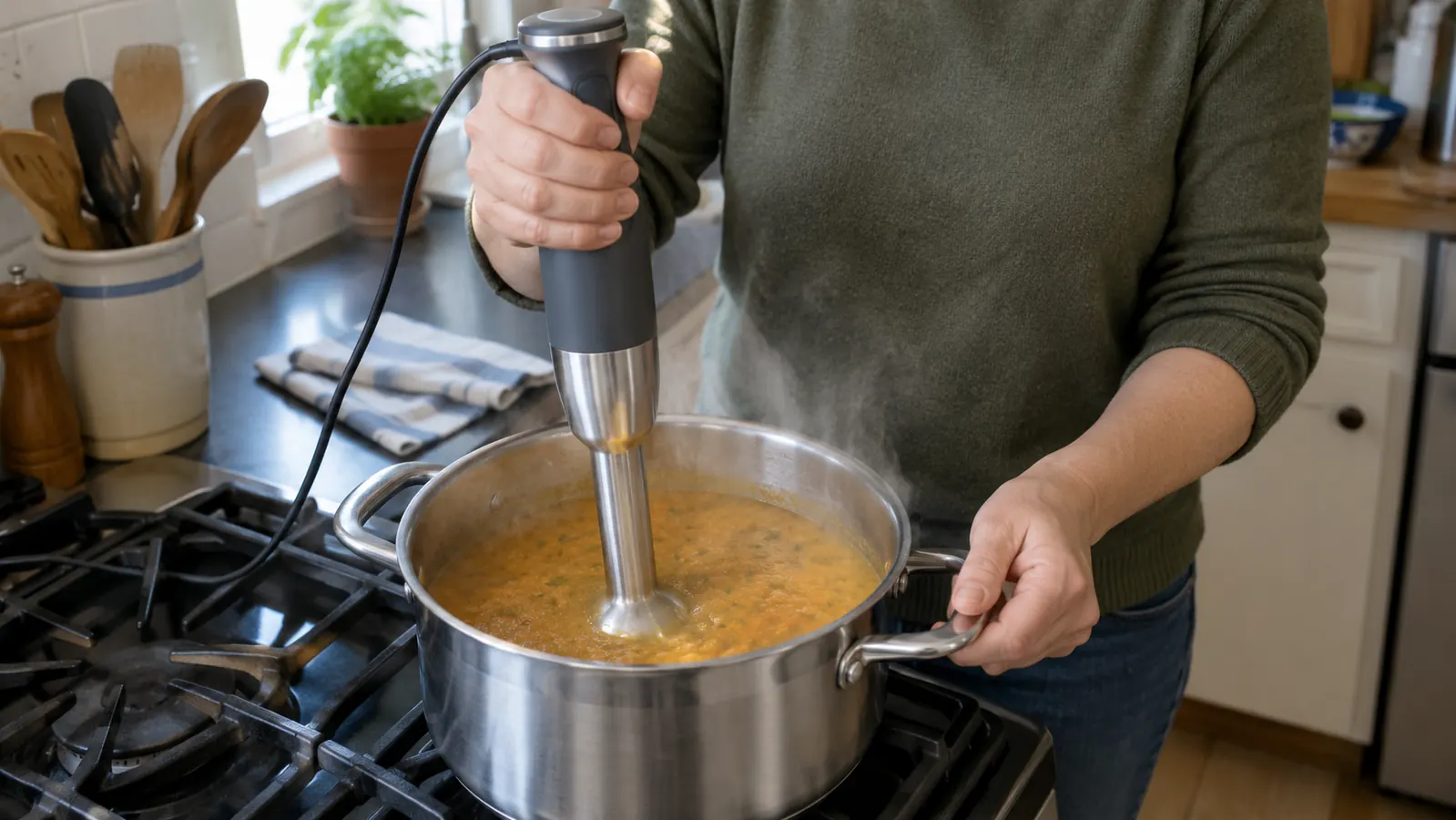
There is also the blend-in-the-pot advantage, which sounds small until you use it. With the hand blender I puree the soup right in the pot it cooked in, no transferring hot liquid into a pitcher, no pouring it back. With the countertop blender I have to wait for the soup to cool enough to handle, transfer it, blend it, and pour it back. For a hot soup on a cold night, that is not a minor convenience, it is the difference between a five minute finish and a fifteen minute one.
Where a Countertop Blender Wins
I am not going to pretend the hand blender replaces a countertop blender, because it does not. The hand blender struggled with a smoothie made from frozen strawberries and a hard banana, leaving chunks I had to run over twice. The countertop blender turned the same ingredients into a completely smooth drink in about forty seconds, and it crushed the ice instead of just pushing it around. If frozen fruit smoothies or iced drinks are a daily habit in your house, the countertop blender is the honest answer, and anyone who tells you otherwise has not tried to make one with an immersion blender.
The other place the countertop blender wins is batch size and hands-free operation. When I make a full pot of Sunday gumbo and want it pureed, the hand blender works, but it takes a while and I have to stand there holding it the whole time. The countertop blender handles a gallon in two batches, and once it is going I can walk away and prep something else while it runs. For a crowd, it is simply the right tool. The hand blender is a weeknight tool. The countertop blender is the Sunday tool, and if you cook for a crowd every week, you will feel that difference every Sunday.
The countertop blender also wins on sheer power for the stubborn jobs. Nut butters, thick hummus, frozen margaritas, anything that needs sustained high speed for a couple of minutes, the hand blender gets hot and tired before the job is done. The countertop blender powers through. These are not jobs I do every week, but when I do them, the countertop blender is the only one of the two that finishes the job without a fight.
For 80 percent of my weeknight cooking, the hand blender is the one I reach for.
If counter space is tight and you cook for one to four people most nights, this is the blender that earns its drawer space. It purees soup in the pot, cleans up in seconds, and stays out of the way when you do not need it.
Amazon Check Today's Price on Amazon →The Variable Speed Dial, and Why It Matters
One detail worth knowing before you buy: the KitchenAid hand blender has a variable speed dial, and that matters more than I expected. For a delicate hollandaise you run it low and gentle, and for a thick soup you run it high, and the difference is real. The lower speeds also keep splatter down, which is the main complaint people have with immersion blenders in general. The trick is to keep the shaft fully submerged before you pull the trigger, then ease the speed up as it blends. Do that and it behaves beautifully. Ignore it and you will redecorate your stove top with tomato soup.
One more practical note. This model is corded, which I actually prefer in a hand blender. A cordless model is handy, but the battery adds weight to the handle and you are always wondering about the charge. The cord is long enough to reach my outlets without stretching, and I never have to think about charging it. For a tool I use a few times a week, that tradeoff is worth it.
The Storage Math
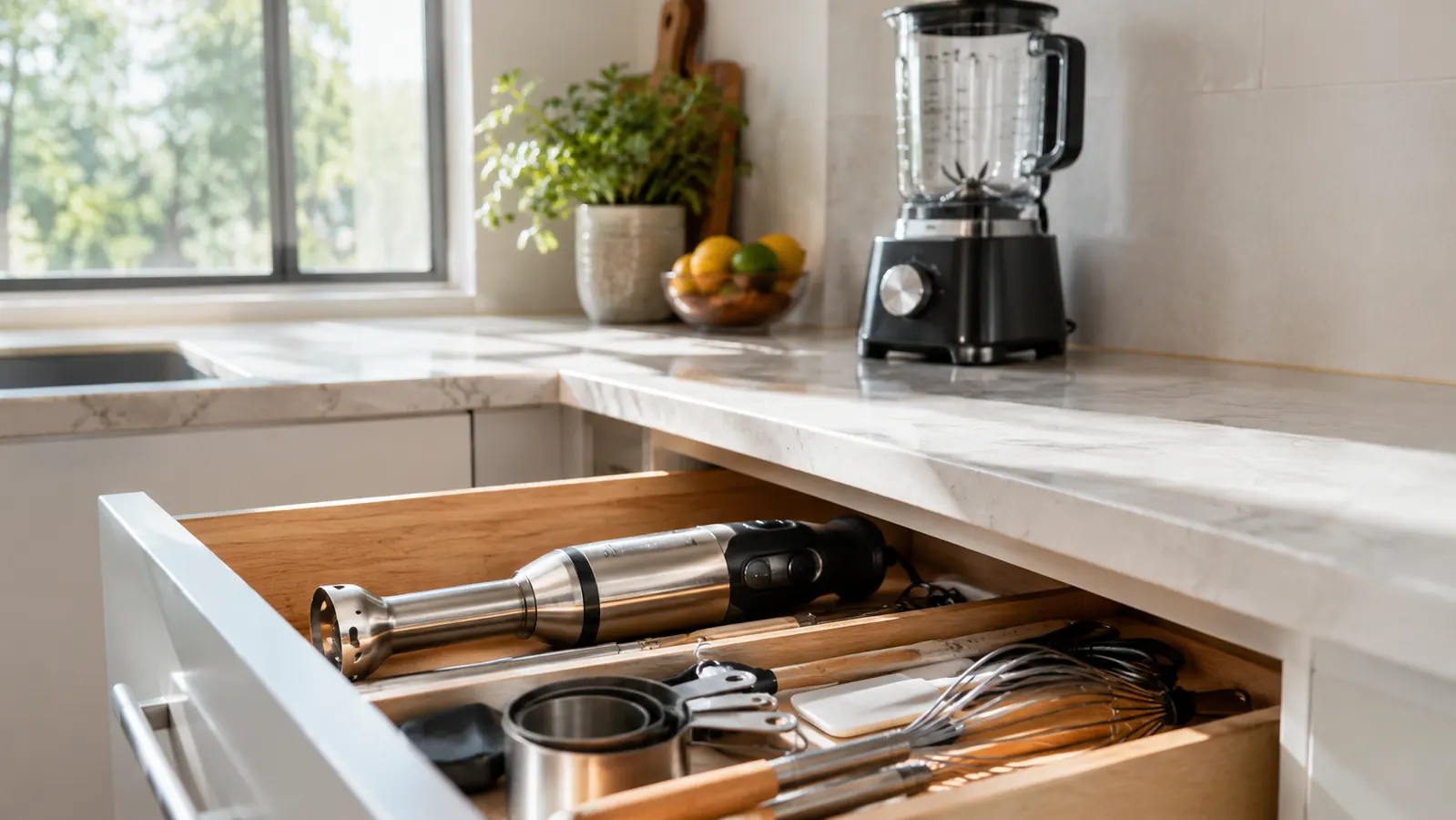
Let me put the storage question in plain terms I can see every day. My countertop blender occupies a footprint roughly the size of a large mixing bowl, and it stands tall enough that it blocks part of the window above my sink. It lives out on the counter because it does not fit anywhere else, and there is nowhere in my cabinets where it fits standing up. The hand blender is about the length of my forearm, and it fits flat in a deep drawer next to the measuring cups. When the drawer is closed, it is gone. For a kitchen that already has a coffee maker, a toaster, and a canister set on the counter, that difference is not cosmetic, it is the whole argument. If you want the longer version of that argument, there is a separate article on this site about why an immersion blender fits a small kitchen.
Who Should Buy Which
Buy the KitchenAid hand blender if you cook for one to four people, if your counter is crowded, if you make soups and sauces more often than frozen drinks, and if you hate washing a pitcher. Buy a countertop blender instead if you make big batches, crush ice or frozen fruit daily, or cook for a crowd every weekend. And if you have the cabinet space and the budget, honestly, you can own both and use each for what it is good at. But if I had to pick one for a small kitchen, I pick the hand blender, and six months ago I did not expect to say that.
The honest caveat is this. If the only blender job you ever do is a frozen fruit smoothie every morning, the hand blender will frustrate you, and you should buy a countertop blender and make peace with the counter space. If your blender job is mostly soups, sauces, and the occasional single smoothie, the hand blender is the better tool and the countertop blender is mostly taking up space. Match the tool to the job you actually do, not the job you imagine you should do.
What I'd Tell a Friend
If you are staring at the same problem I had, a counter that already has too much on it and a blender you barely use, here is my honest counsel from two months of running both. The countertop blender is the more capable machine. The hand blender is the better tool for how most people actually cook, because it is the one they will actually use. Most weeks my hand blender gets used three or four times and the countertop blender gets used once, if that. A tool you reach for is worth more than a tool you have to talk yourself into.
The tool you actually reach for wins, even when it is not the more powerful one.
The Bottom Line
I would not tell you to throw away a good countertop blender, because mine still earns its place on Sunday. But if you are choosing your first blender for a small kitchen, or replacing one that has been gathering dust, the KitchenAid hand blender is the one I would buy. It is small enough to store, quick enough to clean, and capable enough for the cooking most of us actually do on a weeknight. That is a combination the countertop blender cannot match, no matter how powerful it is.
If counter space is your problem, this is the blender for it.
Small enough for a drawer, quick to clean, and capable of every weeknight blending job I have thrown at it. If you want the longer picture, there is a full long-term review of this exact hand blender elsewhere on the site.
Amazon Check Today's Price on Amazon →